


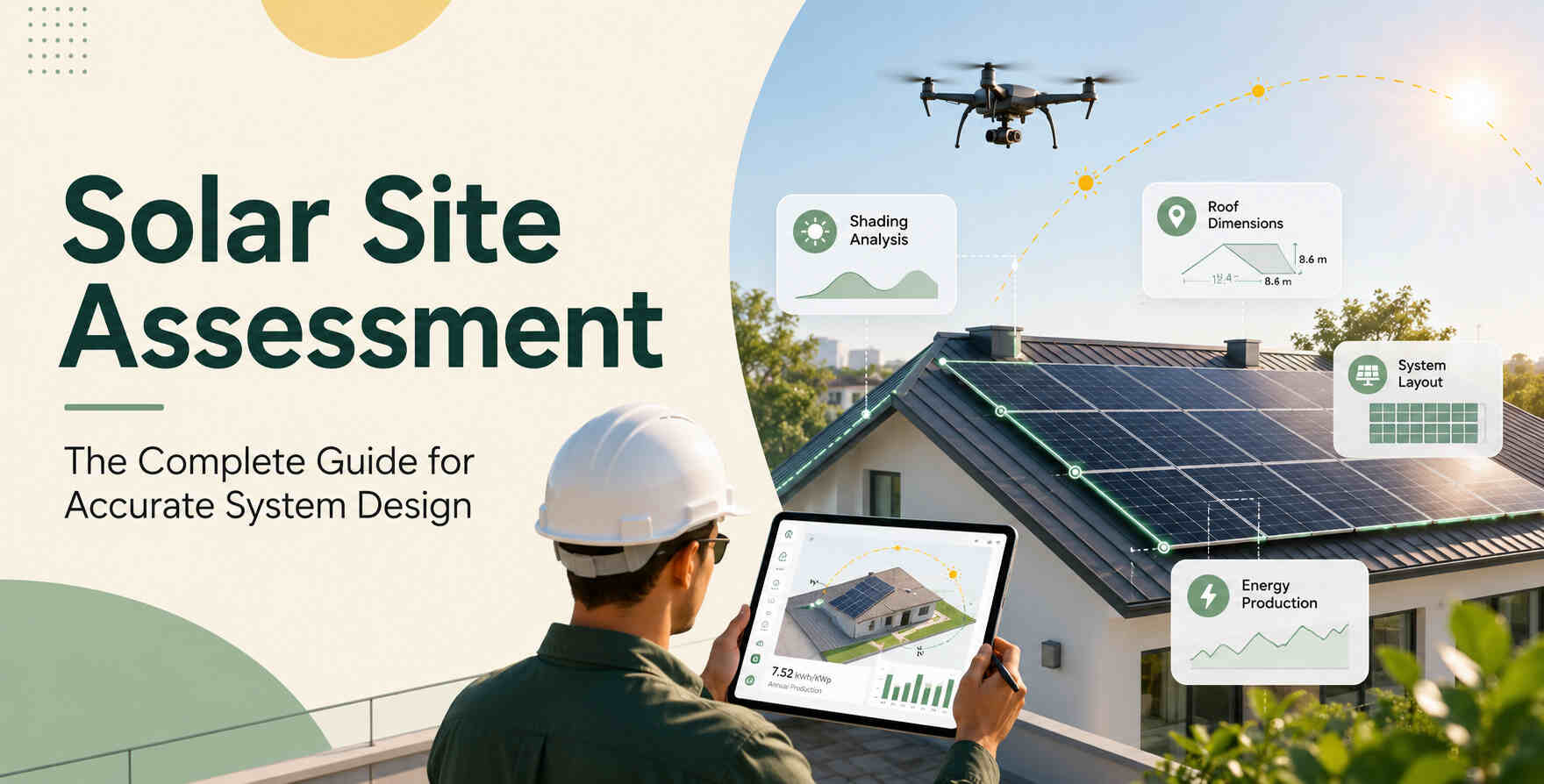
The success of any solar project begins long before panels are installed. Before designing a system or preparing a proposal, installers must understand whether a site is suitable for solar energy generation. This is where a solar site assessment becomes essential.
A proper assessment helps determine how much energy a system can generate and whether the location can support a safe and efficient installation. It also identifies potential challenges early so that costly mistakes can be avoided later.
Whether you are designing a residential rooftop system or a large commercial project a detailed site assessment provides the foundation for accurate planning and better project outcomes.
In this guide, we will explore every aspect of a solar site assessment including surveys, roof inspections, shading analysis, feasibility studies and best practices for accurate solar system design.
A solar site assessment is the process of evaluating a property to determine its suitability for solar panel installation. It involves gathering information about the site conditions, roof characteristics, shading obstacles, structural integrity, electrical infrastructure and energy consumption patterns.
The goal is to understand how much solar energy can be produced and whether the project will be technically and financially viable.
A comprehensive assessment ensures that designers and installers have accurate data before creating system layouts and energy production estimates.
Without a proper assessment, even a well designed solar system may fail to meet performance expectations.
Every solar installation site is unique. Two buildings located in the same neighborhood can have completely different solar potential because of roof orientation, shading conditions and structural limitations.
A detailed assessment helps installers:
When site conditions are thoroughly evaluated, the final system design becomes more accurate and reliable.
A solar site survey involves collecting all the information needed for system design and installation planning.
The survey often includes physical inspections, measurements, photographs and technical evaluations.
The primary objective is to gather accurate site data that can later be used for system sizing and design optimization.
A professional survey helps eliminate assumptions and ensures that every design decision is based on real-world conditions.
The first step is understanding the overall property layout.
Installers assess available installation areas and identify possible obstructions such as nearby buildings, trees, utility poles and mechanical equipment.
The surrounding environment plays a major role in determining long term solar performance.
Electricity usage data provides valuable insight into system sizing requirements.
By reviewing utility bills, installers can understand energy consumption patterns and estimate how much solar capacity is needed to offset electricity usage.
This step helps ensure that the system is appropriately sized for the customer's needs.
The electrical system must be capable of supporting solar integration.
During the assessment, installers inspect electrical panels, service capacity, grounding systems and utility connection points.
This evaluation helps identify potential upgrades that may be required before installation.
A solar roof assessment is a critical component of the evaluation process.
Since rooftop systems heavily depend on the condition of the roof, installers must carefully analyze the structure before proceeding.
Several factors are considered during the assessment.
The roof should be in good condition and capable of supporting solar panels for many years.
If a roof is nearing the end of its lifespan, replacing it before installation may be more cost-effective than removing and reinstalling panels later.
Different roofing materials require different installation techniques.
Asphalt shingles, metal roofs, tile roofs and flat commercial roofs each present unique design and mounting considerations.
Understanding roof materials helps installers select appropriate mounting systems.
Roof direction significantly impacts solar energy production.
In many regions, south-facing roofs receive the highest solar exposure throughout the year.
However, east and west-facing roofs can also provide strong performance depending on project goals.
Roof slope affects both solar exposure and installation requirements.
An optimal pitch can improve energy production while reducing the need for additional mounting adjustments.
.png)
One of the biggest factors affecting solar performance is shading.
Even minor shading can significantly reduce energy generation and system efficiency.
A thorough solar shading analysis helps identify obstacles that block sunlight during different times of the day and year.
Common shading sources include:
Modern assessment tools can model shading patterns and predict annual energy losses.
By understanding shading impacts, designers can adjust panel placement and optimize system performance.
Accurate shading analysis often leads to better production estimates and higher customer satisfaction.
A solar site evaluation combines multiple assessment activities into a complete review of project viability.
This process goes beyond basic measurements and focuses on understanding how all site conditions work together.
Installers analyze solar access, roof characteristics, structural considerations and electrical infrastructure to determine whether the project can proceed successfully.
The evaluation serves as the bridge between data collection and system design.
The more accurate the evaluation, the more accurate the final design will be.
A solar site inspection involves an on-site visit where technicians physically examine the property.
This inspection helps verify information collected through remote tools and satellite imagery.
During the inspection, teams:
Physical inspections reveal important details that may not be visible through aerial imagery alone.
As a result, they remain an important part of many solar development workflows.
Not every site is suitable for solar installation.
A solar feasibility assessment helps determine whether a project can achieve acceptable technical and financial performance.
This evaluation considers factors such as:
The feasibility assessment provides stakeholders with a realistic understanding of project potential before significant investments are made.
For larger commercial and industrial projects, this step is particularly important.
Design accuracy depends heavily on the quality of site data.
A professional solar project site survey provides precise measurements and detailed site information that improve every stage of project development.
Accurate surveys help designers:
When survey data is incomplete or inaccurate, project delays and unexpected costs become more likely.
Therefore, investing time in a detailed survey often saves significant effort later.
Technology has transformed how site assessments are performed.
While traditional field inspections remain valuable, many modern tools now improve efficiency and accuracy.
Drones capture detailed aerial imagery and site measurements.
They provide accurate roof models while reducing the time required for manual inspections.
High-resolution imagery allows installers to perform preliminary evaluations remotely.
This helps identify suitable projects before conducting physical visits.
LiDAR creates highly detailed three-dimensional site models.
It is particularly useful for large commercial projects where precision is critical.
Advanced software platforms can combine aerial imagery, shading data and site measurements into a single design environment.
This improves workflow efficiency and helps teams create more accurate project designs.
Despite advances in technology, site assessments can still encounter challenges.
One common issue is incomplete site information. Missing measurements or inaccurate utility data can affect system sizing and production estimates.
Another challenge is shading variability. Trees grow over time and seasonal changes can alter shading patterns.
Structural concerns can also complicate projects, particularly when older buildings are involved.
In addition, utility requirements and local regulations may introduce additional considerations that must be evaluated during the assessment process.
Recognizing these challenges early helps project teams develop better solutions.
An accurate solar site assessment is the foundation of a successful solar project. The quality of the final system design directly depends on the quality of the data collected during the assessment phase. Following a few proven best practices can significantly improve design accuracy and overall project outcomes.
Remote assessment tools provide valuable preliminary insights, but they should be complemented with on-site inspections whenever possible. This approach helps identify site-specific conditions that may not be visible through satellite imagery or digital models.
Capture detailed photographs and record accurate measurements during the assessment process. Maintaining comprehensive notes on roof conditions, obstructions, electrical equipment, and structural features helps prevent costly errors during the design and installation stages.
Even minor shading can have a noticeable impact on solar energy production. Assess shading patterns throughout the day and across different seasons to develop realistic performance estimates and optimize panel placement.
Before finalizing the system design, evaluate the condition and capacity of the existing electrical system. Confirming panel capacity, wiring conditions and interconnection requirements helps avoid unexpected complications during installation.
Modern solar design and assessment tools improve measurement accuracy, streamline calculations, and support better project modeling. Using reliable software ensures that system designs are based on accurate data and realistic performance projections.
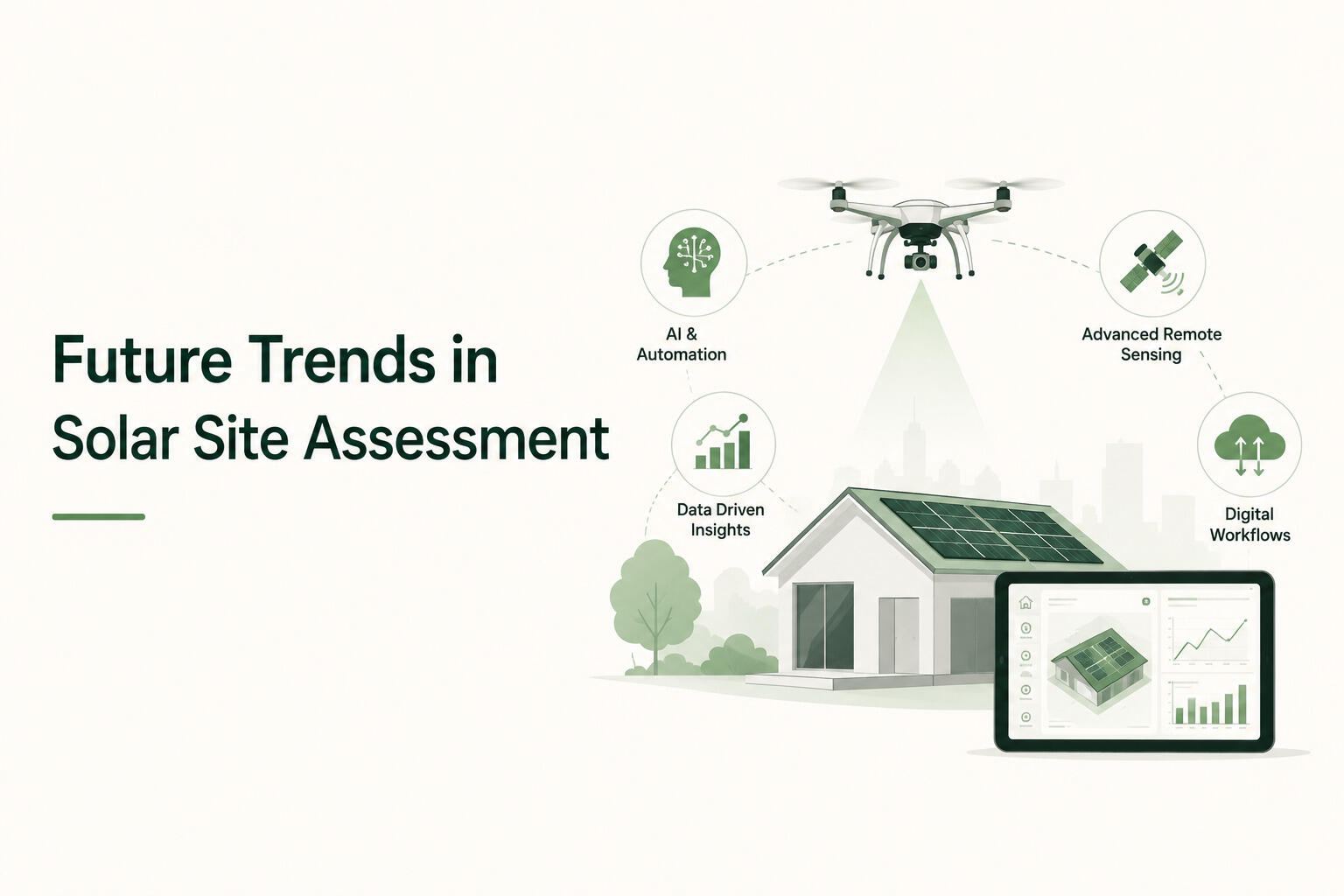
Solar site assessment is becoming smarter, faster, and more data driven as new technologies continue to reshape the industry.
Artificial intelligence is helping automate many aspects of site analysis, from identifying roof characteristics to evaluating shading and optimizing system layouts. At the same time, machine learning models are improving the accuracy of energy production forecasts.
Drones are becoming more capable and accessible, allowing solar professionals to capture highly detailed site data with greater speed and precision. This reduces the need for manual measurements and improves overall assessment accuracy.
Modern satellite imagery, LiDAR data, and digital mapping tools are making remote site assessments more reliable than ever. As these technologies improve, teams can evaluate projects faster while minimizing the number of site visits required.
Digital assessment and design workflows are streamlining project development from start to finish. By reducing manual tasks and improving data sharing, solar teams can complete evaluations more efficiently and accelerate project timelines.
Ans. A solar site assessment is the process of evaluating a property to determine whether it is suitable for solar panel installation. It includes roof evaluation, shading analysis, structural review and electrical assessment.
Ans. A solar site survey helps collect accurate site data which improves system design accuracy, reduces installation risks and provides reliable energy production estimates.
Ans. A solar roof assessment examines roof condition, age, orientation, pitch, structural strength and available installation space to determine whether the roof can support a solar system.
Ans. Solar shading analysis identifies objects that block sunlight. Understanding shading impacts helps optimize panel placement and improve overall energy generation.
Ans. A solar feasibility assessment evaluates whether a solar project is technically and financially viable based on site conditions, energy production potential and expected project economics.
Ans. Most residential solar site inspections take a few hours while larger commercial projects may require additional time depending on site complexity and project size.
.png)
Every successful solar project begins with a solid site assessment. Taking the time to evaluate the roof, analyze shading, and verify electrical conditions helps ensure the system is designed for long term performance and reliability.
The more accurate the site data, the easier it becomes to make informed design decisions and avoid costly surprises later in the project. And with modern tools making the assessment process faster and more efficient, solar professionals can deliver better results with greater confidence.
ARKA 360 helps simplify this workflow by bringing site modeling, system design, and proposal creation together in one powerful solar design software solution.

