


.jpg)
Should you install solar panels on your roof or on the ground?
It's one of the biggest decisions when planning a solar project. While both systems generate clean energy and lower electricity bills, the right choice depends on your available space, budget, and energy goals.
When comparing ground mount vs rooftop solar, there's. A rooftop system makes the most of existing roof space, while a ground-mounted system offers greater flexibility and room for future expansion.
In this guide, we'll compare both options, explain their key differences, and help you choose the system that's best for your project.
The difference between ground mount and rooftop solar is exactly what the name suggests. One system is installed on the roof of a building, while the other is installed on a structure built directly on the ground.
A rooftop solar system is attached to the roof using mounting rails. Since the roof already exists, there's no need to build a separate support structure. This makes rooftop systems a popular choice for homes and commercial buildings.
A ground-mounted system, on the other hand, is installed on a metal structure anchored into the ground. Because it's not limited by the size or shape of a roof, it offers more flexibility when it comes to panel placement.
Both systems generate electricity in the same way. The biggest differences come down to design, installation, maintenance, and the amount of space available.
There are several solar installation types, but rooftop and ground-mounted systems are by far the most common.
Rooftop installations are ideal for properties that have a strong roof with good sun exposure. They make use of unused roof space and are often the most practical option in cities where land is limited.
Ground-mounted systems are better suited for larger residential properties, farms, commercial buildings, and industrial sites that have enough open land. Since they're installed separately from the building, designers have more freedom to create the most efficient layout.
Understanding these installation types makes it much easier to choose the right solution for your property.
.png)
One of the biggest advantages of ground-mount solar design is flexibility.
Instead of working around the size and shape of a roof, designers can position the panels where they'll receive the most sunlight throughout the day. They can also choose the ideal tilt and orientation to maximize energy production.
Another benefit is spacing. Since there's usually more room available, panels can be arranged to reduce shading between rows and improve airflow. This helps the system perform efficiently throughout the year.
Ground-mounted systems are also easier to expand. If your energy needs grow in the future, adding more panels is often much simpler than it would be with a rooftop installation.
That's why this type of design is commonly used for larger projects where performance and future growth are important.
Rooftop solar design takes a different approach because the roof becomes the foundation for the entire system.
Before designing the layout, installers evaluate the roof's size, direction, slope, and condition. They also check for obstacles like chimneys, skylights, vents, or air conditioning units that could affect panel placement.
Shading is another important factor. Trees or nearby buildings can block sunlight during certain times of the day, reducing the amount of electricity the system produces.
Even though rooftop systems have more design limitations than ground-mounted systems, they remain one of the most popular choices because they make good use of existing space without taking up valuable land.
If you're still deciding between the two, here's a quick comparison.
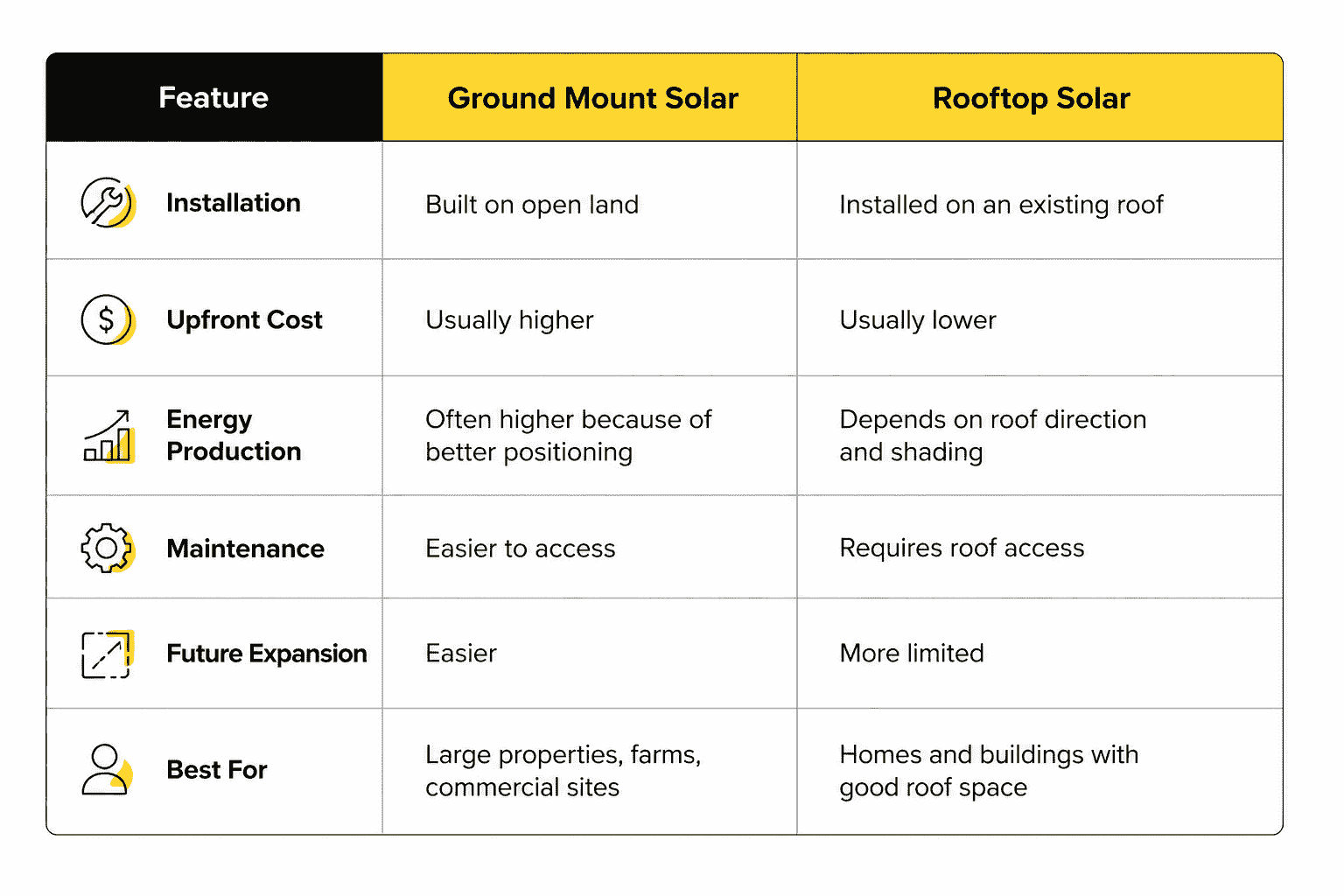
Both options can deliver excellent results when they're designed correctly. The right choice depends on your property's layout and your energy goals.
If maximum energy production is your priority, ground-mounted systems often have the advantage.
That's because they can be positioned at the ideal angle and direction to capture the most sunlight throughout the day. Some systems can even include solar trackers that follow the sun, helping generate even more electricity.
That said, a well designed rooftop system can still perform extremely well. If your roof faces the right direction and receives plenty of sunlight, the difference in energy production may not be significant.
The most important factor isn't where the panels are installed. It's how well the system is designed.
For many people, cost plays a major role in the decision.
In general, rooftop systems are less expensive to install because the roof already provides the support structure. This means fewer materials and less construction work.
Ground-mounted systems usually cost more because they require foundations, mounting structures, trenching, and additional electrical work.
However, it's important to look beyond the initial price. Since ground-mounted systems can often produce more electricity, they may provide greater savings over the life of the system.
Instead of focusing only on the upfront investment, consider the long-term value each option offers.
Once your solar system is installed, you'll want to keep it running efficiently for years to come. That's where maintenance comes in.
The good news is that both ground-mounted and rooftop systems require very little maintenance. However, ground-mounted systems are generally easier to clean and inspect because they're installed at ground level.
If a panel needs to be replaced or wiring needs to be checked, technicians can usually complete the job much faster. There's no need for ladders or special safety equipment, which can also help reduce maintenance costs.
With a rooftop solar system, maintenance can be slightly more challenging. Accessing the roof takes more time, and safety measures are needed before any work begins. Even so, regular inspections and occasional cleaning are usually enough to keep the system performing well.
The installation process looks different for each system.
A rooftop installation is often quicker because the roof already acts as the foundation. Once the roof has been inspected and approved, installers can begin mounting the panels.
Ground-mounted systems require a little more preparation. The land may need to be cleared or leveled, and the support structure has to be installed before the panels are mounted.
That doesn't necessarily make one option better than the other. It simply means the installation process depends on your property.
Permits and local regulations can also influence the timeline, so it's always worth checking the requirements before starting your project.
The best place to start is by looking at your property and thinking about your future energy needs.
If you have plenty of open land, a ground-mounted system gives you more flexibility and makes it easier to expand your system later. But if your roof gets plenty of sunlight and you don't have much extra space, a rooftop system is usually the more practical choice.
Check the condition of your roof before installing solar panels. An older roof may need repairs first, which can help you avoid extra costs down the road. Look out for trees or nearby buildings that could cast shadows on your panels and reduce energy production.
Finally, think about your local weather and whether your electricity needs are likely to grow in the future. Taking a few minutes to consider these factors now can help you choose a solar system that delivers reliable performance for years to come.

You need to find the best layout, check for shading, estimate energy production, and make sure the design meets your customer's needs. Doing all of that manually can be time-consuming and leave room for mistakes.
That's where ARKA 360 helps. It brings the entire design process into one place, making it easier to create accurate layouts, visualize the system in 3D and see how it will perform before installation begins.
ARKA 360 helps you spend less time on manual work and more time designing systems your customers can trust.
Q. 1. What is the difference between ground mount and rooftop solar?
Ans. The main difference is where the panels are installed. A rooftop system is mounted on a building's roof, while a ground-mounted system is installed on a separate structure built on the ground.
Q. 2. Which is better, ground mount or rooftop solar?
Ans. It depends on your property and energy needs. Ground-mounted systems offer more flexibility and are easier to maintain, while rooftop systems are usually more affordable and make use of existing roof space.
Q. 3. Are ground-mounted solar panels more efficient?
Ans. They can be. Since they can be positioned at the ideal angle with fewer design limitations, they often produce more electricity than rooftop systems.
Q. 4. Can every roof support solar panels?
Ans. Not always. The roof should be in good condition, strong enough to support the system, and receive enough sunlight throughout the day for the best performance.
Q. 5. Which solar installation type is easier to maintain?
Ans. Ground-mounted systems are generally easier to clean, inspect, and repair because they're more accessible than rooftop systems.
Q. 6. Does solar design software help with both rooftop and ground-mounted systems?
Ans. Yes. Modern solar design software helps professionals create accurate layouts, analyze shading, estimate energy production, and generate professional proposals for both types of solar installations.
.png)
When it comes to ground mount vs rooftop solar, there's no one size fits all answer. The right choice depends on your available space, budget, energy goals, and future plans.
A rooftop system is ideal for making the most of existing roof space, while a ground mounted system offers greater flexibility and easier expansion.
Whichever option you choose, a well planned design is the key to long term performance. With the right tools, you can create an efficient system that meets your needs today and in the future.
ARKA 360 helps solar professionals simplify the design process, optimize system performance, and create professional proposals with modern solar design software.

