


.jpg)
How many solar panels do I need to power my home?
This is the most asked question when planning to go solar. And honestly the answer is different for every home.
The good news is that once you understand a few basics, it becomes much easier to estimate the right system size for your home.
This guide will help you figure it out step by step.
The number of solar panels you need depends on three main factors:
Understand these three things and you can quickly estimate the total number of panels required.
Let’s say- Your home uses more electricity so obviously you’ll need more panels. But if you use energy efficiently then you can reduce the number of panels needed.
Let’s simplify the concept.
A solar panel calculator works by converting your electricity usage into the required solar power capacity. This capacity is usually measured in kilowatts.
Here is a simple formula that most professionals use.
Total system size needed in kW equals
Your monthly electricity consumption divided by average peak sunlight hours divided by 30
Let us break it down in simple terms.
If your home consumes 900 units per month and your location gets around 5 peak sunlight hours per day then your calculation would look like this.
900 divided by 30 equals 30 units per day
30 divided by 5 equals 6 kW system required
So now you know that you need around a 6 kW solar system.
Another simple way to think about this is through daily usage.
If you know how many units of electricity you consume every day, then you can directly estimate your solar requirement.
For example
Once you know how much electricity your home uses every day the calculation becomes much simpler.
For example, if your home uses 15 units of electricity daily and your area receives around 5 hours of good sunlight then you would need approximately a 3 kW solar system.
That is why it is often easier to estimate your solar requirement using daily electricity usage instead of only looking at monthly bills.
.png)
Now that you know the system size, the next step is to convert that into the number of panels.
Most modern solar panels in 2026 come with higher efficiency and power ratings between 400 watts and 550 watts.
Let us assume you are using 500 watt panels.
If you need a 5 kW system, then the calculation would be: 5000 watts divided by 500 watts per panel equals 10 panels.
For a home the solar panels needed for a house can range between 8 and 20 panels depending on energy usage.
Here is a quick reference
If you want a faster approach, then you can use a simple thumb rule as a solar system size calculator.
For every 100 units of monthly electricity usage, you need around 1 kW of solar capacity.
So if your monthly bill shows 800 units, then
800 divided by 100 equals 8 kW system
This rule is not exact but it gives you a quick starting point before you do detailed calculations.

Let us look at common household scenarios.
Electricity usage is usually low.
Required system size is between 1 kW and 3 kW
Average families with multiple appliances
Required system size is between 3 kW and 6 kW
High consumption, including air conditioners and heavy loads
Required system size is between 6 kW and 10 kW or more
So when you ask how many kW solar system do I need, the answer depends on your lifestyle and energy habits.
This is one of the most searched questions and the answer depends more on electricity usage than on the house size.
But generally, a 2000 sq ft home falls into the medium to large category.
If the home consumes around 900 to 1200 units per month, then it would need a 6 kW to 8 kW system.
With 500 watt panels, this means: 12 to 16 panels, approximately. So if you are wondering how many solar panels for a 2000 sq ft house, then expect a range between 12 and 18 panels, depending on usage.
Even though calculations give you a rough idea, there are a few real world factors that can change your final number.
Sunlight varies from location to location and this directly affects how much electricity your panels can generate. Cities with strong and consistent sunlight need fewer panels because each panel produces more energy. On the other hand, areas with frequent clouds, dust or pollution may require more panels to achieve the same output.
Your roof size and layout decide how many panels you can install. If your roof is small or has obstructions like water tanks or shading, then space becomes a limitation. In such cases using high efficiency panels helps you generate more power in less area.
Not all solar panels perform the same. Higher efficiency panels convert more sunlight into electricity which means you need fewer panels for the same system size. Lower efficiency panels may cost less but they require more space.
Every solar system experiences small losses due to wiring temperature and inverter performance. Because of this, installers usually add a little extra capacity to make sure your system meets your actual energy needs.
Energy consumption often increases over time. If you plan to buy an electric vehicle or add new appliances, then it is smart to install a slightly larger system now so you are prepared for future demand.
Many homeowners ask if they should install exactly what they need or slightly more.
The truth is, energy usage often increases over time and electricity prices keep rising.
So installing a slightly larger system today can help you save more in the long run.
Also, net metering policies in many regions allow you to export extra energy back to the grid which improves your return on investment.
Another practical consideration is space.
On average, one solar panel takes around 17 to 22 square feet.
So if you need 10 panels, then you need around 200 square feet of shadow free space.
If your roof is limited, then you can use high efficiency panels to reduce the number of panels required.
Solar has become much more affordable in 2026 because panel prices have stabilized and government subsidies are helping homeowners reduce upfront costs.
According to 2026 residential rooftop solar market estimates and PM Surya Ghar subsidy guidelines, solar installation costs in India range between ₹55 to ₹75 per watt depending on equipment quality, inverter brand and installation complexity.
Here is the average rooftop solar pricing in India for 2026.
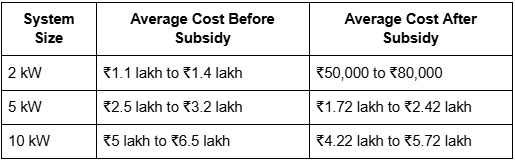
The final price depends on factors like panel efficiency, inverter quality, roof type and installation complexity. Homes with premium high efficiency panels may cost more initially but they often generate better long term savings.
Government schemes like the PM Surya Ghar Muft Yojana are also making rooftop solar more accessible for homeowners across India by offering subsidies for residential installations.
Most homeowners recover their solar investment within 4 to 6 years through electricity bill savings and net metering benefits. After that the system continues generating low cost electricity for 20 to 25 years.
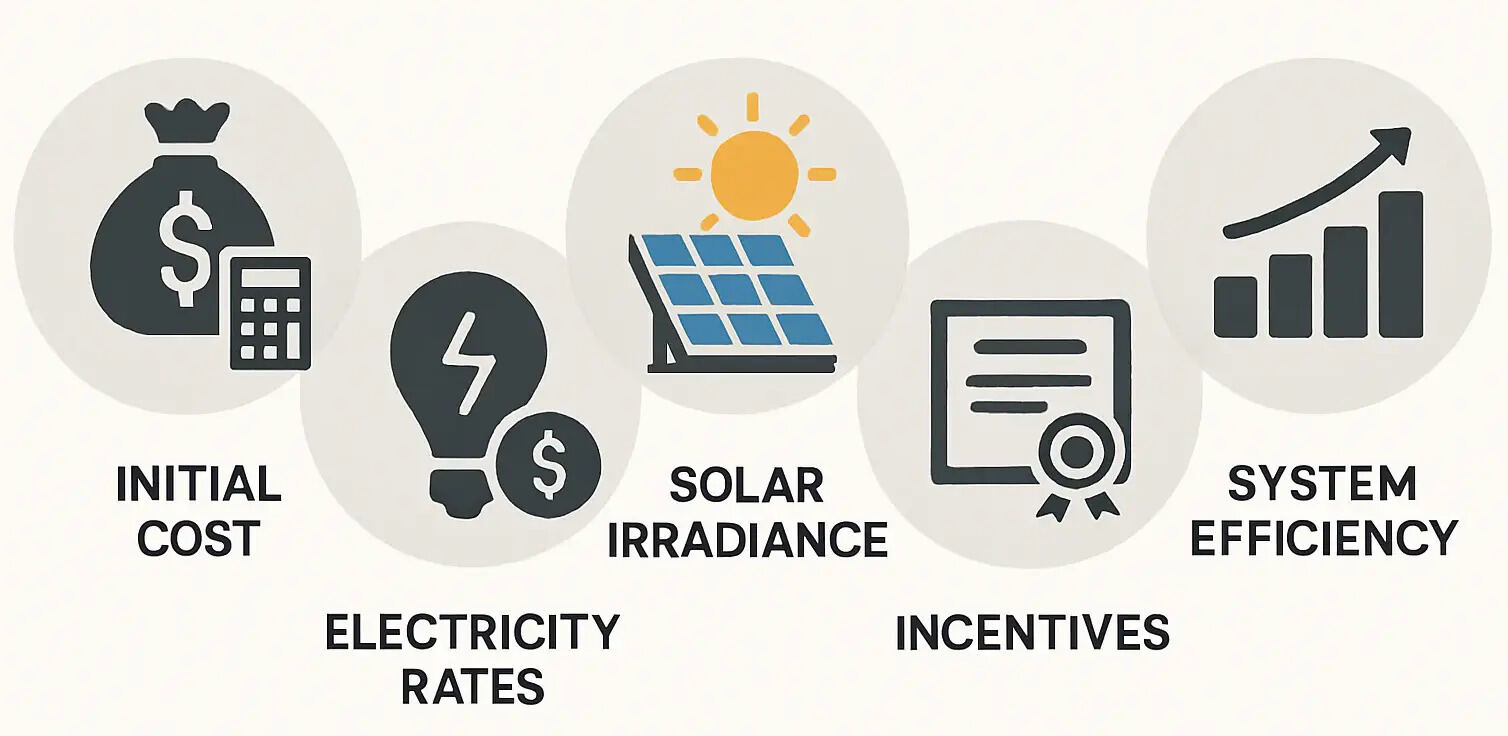
Many homeowners rush into solar decisions without properly understanding their energy requirements and this often leads to systems that are either too small or unnecessarily oversized.
Here are some of the most common mistakes people make while estimating their solar needs.
One of the biggest mistakes is estimating solar requirements without checking real electricity consumption. Many people only look at one month of electricity bills instead of reviewing yearly usage patterns. Seasonal changes especially during summer and winter can significantly affect energy consumption. A proper calculation should always consider average annual usage for better accuracy.
A solar system should not only match your current needs but also future requirements. Many homeowners later purchase electric vehicles, add air conditioners or expand their homes which increases electricity demand. If future upgrades are ignored, then the system may become insufficient within a few years.
Cheaper panels may seem attractive initially but lower-quality equipment can reduce long term performance and efficiency. High-quality panels usually offer better energy generation, longer warranties and improved durability which can provide greater savings over time.
Solar systems naturally experience small energy losses due to wiring, inverter conversion dust, heat and shading. Many people calculate system size without considering these losses and later discover that the actual output is lower than expected. Installers usually add extra capacity to compensate for this.
Roof orientation and nearby shade from trees, buildings or water tanks can impact solar production significantly. South-facing roofs generally perform best in India while shaded roofs may require additional panels to maintain output.
Avoiding these mistakes can help homeowners design a more efficient solar system with better savings and long-term performance.
Q. 1 How many solar panels do I need for an average home?
Ans. An average home typically needs 8 to 15 solar panels depending on electricity consumption, panel wattage and sunlight availability.
Q. 2 How many kW solar system do I need for my house?
Ans. Most residential homes require a 3 kW to 8 kW solar system based on monthly electricity usage and appliance load.
Q. 3 What is the easiest solar panel calculation formula?
Ans. Divide your monthly electricity units by 30 and then divide the result by average daily sunlight hours to estimate system size.
Q. 4 How many solar panels for a 2000 sq ft house?
Ans. A 2000 sq ft house usually requires 12 to 18 solar panels, depending on energy usage and panel efficiency.
Q. 5 Can I install extra solar panels for future needs?
Ans. Yes. Installing extra panels is recommended if you plan to add electric vehicles, air conditioners or new appliances later.
Q. 6 How accurate is a solar system size calculator?
Ans. A solar system size calculator provides a strong estimate but professional solar design gives more accurate sizing and output analysis.
.png)
The process is straightforward when broken down. First, calculate your electricity consumption then convert it into system size and finally divide it by panel wattage to get the number of panels.
But while these calculations give you a strong starting point, the real advantage comes from proper planning and smart system design.
This is where ARKA 360 plays an important role. It helps professionals and businesses create accurate layouts and proposals faster so that solar installations are more efficient and reliable.
And if you are looking to simplify this entire process, then using solar design software can help you move from estimation to execution with much more confidence.

