


.jpg)
Going solar in India sounds simple. Install panels and reduce electricity bills.
But on the ground, things are rarely that straightforward.
Projects get delayed. Approvals take longer than expected. And sometimes, systems do not deliver the savings customers were promised.
In most cases, the issue is not technology. It is policy.
And at the center of it is Net Metering India.
Many installers assume the rules are the same everywhere. But each state has its own limits and approval processes and billing structures. Even small gaps in understanding can lead to incorrect system sizing or approval delays or lost trust.
At the same time, policies are evolving. The government is pushing rooftop adoption, while DISCOMs are adjusting how energy exports are handled.
This makes one thing clear.
Understanding solar policy in India, rooftop solar regulations and grid connection solar requirements is essential for successful project execution.
Net metering is a billing system that allows solar users to export excess electricity to the grid and receive credits.
During the day, when generation is higher than consumption, extra power flows to the grid. Later, when consumption increases, electricity is drawn back.
The final bill reflects the net difference.
This simple mechanism directly impacts savings. And that is why net metering in India plays such a critical role in customer decisions.
For installers, it also shapes system design. When policies are favorable, systems can be sized close to full consumption. When they are not, oversizing can reduce returns.
At a national level, the framework for net metering in India is clear. But implementation varies across states.
Under current rules, net metering is typically allowed up to 500 kW or sanctioned load, whichever is lower, as outlined by the Ministry of New and Renewable Energy.
India has already crossed 23 GW of rooftop solar capacity, but growth is still uneven. Policy differences and inconsistent execution continue to slow adoption in several regions.
In practice, installers must navigate:
This makes it essential to approach every project with a clear understanding of local solar policy in India rather than relying on general assumptions.
.png)
When customers ask about savings, they are really asking how electricity will be billed.
In net metering India, exported electricity is credited at the same rate as consumed electricity. This makes it the most beneficial model, especially for residential users, because excess energy retains full value.
Gross metering works differently. All generated electricity is exported to the grid, and the consumer buys electricity separately. The export tariff is fixed and usually lower than retail rates.
Net billing sits in between. You can consume your solar power, but exported electricity is compensated at a lower rate than what you pay for electricity.
This difference matters more than it seems.
Under net metering, exporting energy does not reduce value. Under net billing, it does. So a system that looks efficient on paper may not perform financially if the billing structure is not considered.
This is why billing mechanisms are central to how solar policy in India is evolving.
System design is no longer just about rooftop space or budget.
It begins with policy.
A typical solar system in India generates most of its energy during midday hours. But most households consume more electricity in the evening. This creates a natural mismatch.
Under net metering in India, this mismatch is not an issue. Excess energy is exported and credited for later use.
But under net billing, exported electricity has a lower value. Which means oversizing a system can reduce financial returns.
Because of this, installers must take a more calculated approach.
Systems are often sized close to full consumption in net metering scenarios, but more conservatively in net billing cases.
Even small sizing errors can impact overall savings.
So understanding rooftop solar regulations is not just about approvals. It is essential for accurate system design.
If there is one thing installers often underestimate, it is how much rooftop solar regulations change from one state to another.
India follows a central framework, but each state and DISCOM applies its own rules. These differences directly affect system sizing and financial performance.
Instead of looking at policies individually, it is more useful to group states based on how their regulations behave.
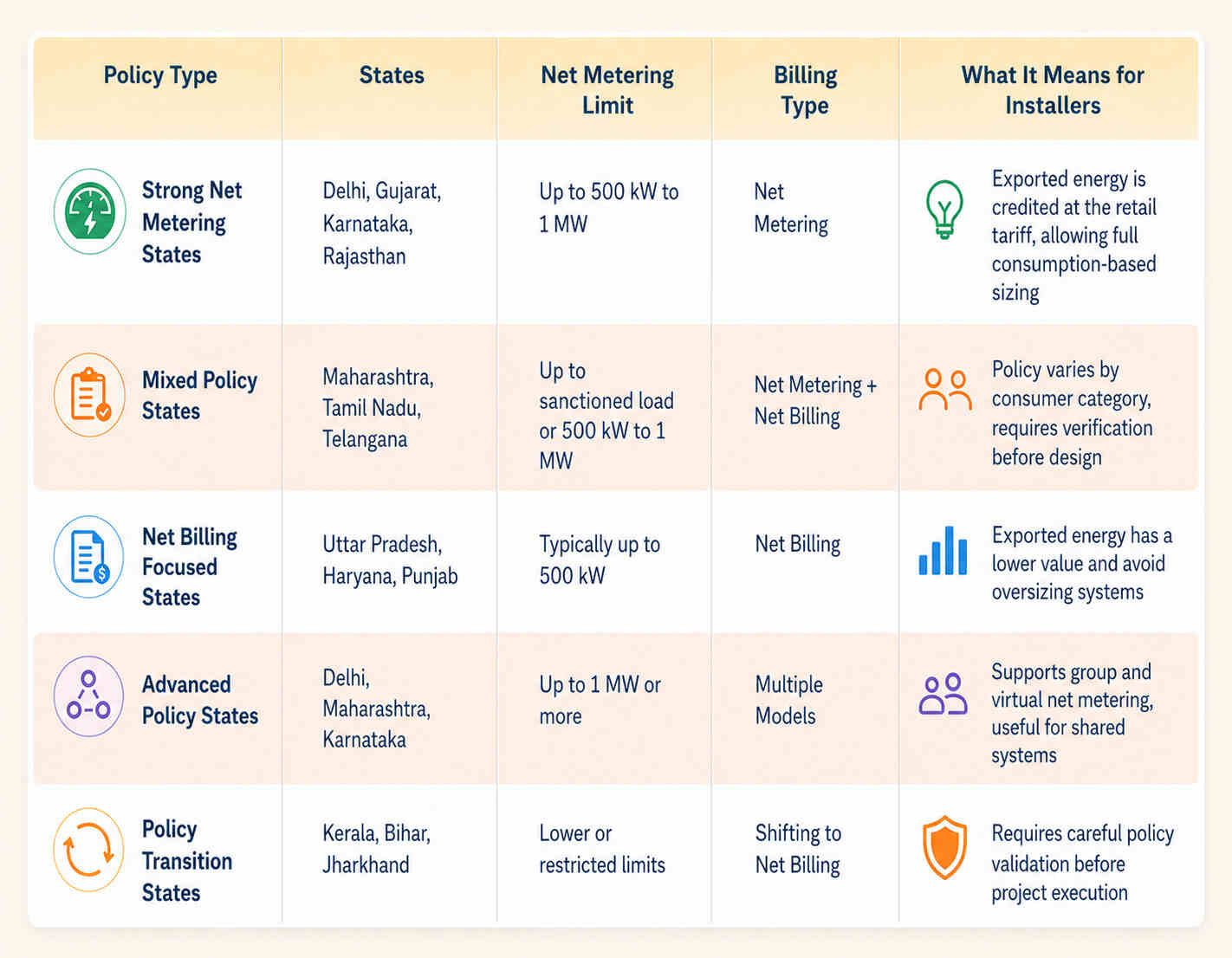
These differences directly impact how systems should be designed.
A system that works well in Delhi may not deliver the same results in Uttar Pradesh. A commercial project viable in Gujarat may not perform similarly in a net billing state.
This is why installers must always verify:
Because in reality, understanding rooftop solar regulations is not just about compliance.
It is about designing systems that deliver expected savings.
Connecting a system to the grid is not just a technical step. It involves coordination and compliance.
Understanding grid connection solar requirements helps avoid delays.
Most DISCOMs require bi-directional meters, certified inverters, safety systems, and complete documentation.
While the process is structured, delays often happen during inspections or meter installation.
In many cases, the issue is not installation quality but documentation gaps.
A well-prepared application and accurate documentation can significantly reduce approval time.
As the industry grows, solar compliance in India is becoming more structured and more important.
Compliance includes using certified components, following safety standards, completing approvals, and submitting correct documentation.
Many delays in rooftop solar projects are linked to compliance gaps rather than installation issues.
Ensuring that all regulatory requirements are met from the beginning helps avoid rework and ensures smoother project execution.

The future of solar policy in India is moving toward balance.
Net metering will likely continue for residential users because it supports adoption and simplifies savings.
However, commercial and industrial users are gradually shifting toward net billing models, a trend also highlighted in research by the Council on Energy, Environment and Water.
At the same time, battery storage is becoming more relevant. Instead of exporting excess energy at lower rates, users can store it and use it later.
Digital approvals and smarter grid systems are also improving how solar projects are processed and managed.
For installers, this means adapting to changing policies and focusing on accurate system design.
Because the industry is not just growing. It is evolving.
Q. 1) What is net metering in simple terms?
Ans. Net metering allows solar users to export excess electricity to the grid and receive credits that reduce their electricity bills.
Q. 2) Is net metering available across India?
Ans. Yes, net metering is available across India, but policies and limits vary depending on the state and local DISCOM regulations.
Q. 3) What is the system size limit under net metering in India?
Ans. The system size limit is typically up to 500 kW or sanctioned load, depending on state-specific solar policy and India guidelines.
Q. 4) How long does the grid connection solar approval take?
Ans. Approval timelines usually range from a few weeks to a couple of months, depending on DISCOM processes and documentation accuracy.
Q. 5) Can commercial users use net metering?
Ans. Some states allow it, but many commercial and industrial users are gradually being shifted toward net billing models for solar systems.
Q. 6) Why is solar compliance in India important?
Ans. Solar Compliance India ensures proper approvals, safe installations, and smooth grid connection, while also preventing delays and regulatory issues during execution.
.png)
Net metering is not just a policy detail. It defines how solar projects perform.
And in India, net metering is shaped by central guidelines and state-level execution.
They design better systems, avoid delays and build stronger customer trust.
Because today, solar is not just about installation. It is about delivering clarity.
ARKA 360 can also support installers at the design stage by helping simulate policy scenarios and align system sizing with actual net metering outcomes.
And that clarity comes from accurate design and policy-aligned proposals. This is where ARKA 360 helps simplify workflows and enables faster and more accurate proposals using advanced solar design software.

